Deel's own website appears in Google's top 10 for 17% of the global hiring questions we tested. AI tools name Deel in 89% of their answers to the same questions. BambooHR's site never made Google's top 10 for an HR software question, yet AI names it in 66% of answers.
If ranking on Google decided who AI recommends, those numbers would be close. They are not. This report sets out what does decide it, at least for one market, measured rather than guessed.
The AI Visibility Index for HR, payroll and global hiring is a snapshot of 1,554 answers from five AI tools to 120 questions that HR, finance and operations buyers ask, collected on 22 October 2026. It covers 70 vendors in three categories: employer of record (EOR) and global hiring, HR software, and payroll.
Key findings
- Three vendors appear in most answers in every category. Deel (89%) and Remote (87%) in global hiring; Rippling (67%) and BambooHR (66%) in HR software; ADP (67%) and Gusto (64%) in payroll. The top three take 42%, 31% and 29% of all vendor mentions in their categories.
- Ranking on Google and being named by AI are different contests. Only 8% to 29% of the sites an AI tool cites also rank in Google's top 10 for the same question.
- 57% of the sources AI cites are HR companies' own websites. Half of that is the vendors being ranked; the other half is other HR companies, often publishing "best provider" lists that rank their competitors. Reddit and forums supply under 2%.
- Some brands are visible on reputation, others only through sources. With web search off, AI tools name Deel as often as with it on (93%). RemoFirst goes from 7% to 37% when search is on: its visibility comes almost entirely from what AI reads.
- Each tool tells a different story. Two tools answering the same question name only about half the same vendors, and cite between 4% and 14% of the same websites.
How we ran the study
We wrote 120 questions the way buyers ask them: "best employer of record for hiring in Spain", "we're a 40-person company still using spreadsheets for HR, what should we switch to?", "how much does payroll software cost for 20 employees?". Forty per category, covering best-of, use case, pricing, problem and country questions, including Spain, the UK, Germany and the US. Two are in Spanish and one in German.
Each question went to ChatGPT, Gemini, Perplexity and Claude through their official APIs with web search switched on, three times each, because answers change from one ask to the next. Google AI Overviews were collected once per question from Google search results. A language model then read every answer and listed the vendors it named, in order, and we classified every website the tools cited.
Thirty questions name a brand ("alternatives to Deel", "HiBob vs Personio"). They are excluded from the rankings, because naming a brand in the question hands it a mention, and analysed separately in the challenger map. The full method and its limitations are at the end, and every ranking can be explored by AI tool and country on the data page.
Who gets named
Visibility is the share of answers that name a vendor. It is the headline measure here, because it is stable when averaged across many answers. Rank position is not: the order of a list changes most times a question is asked again, a pattern SparkToro and Gumshoe documented across ChatGPT, Claude and Google earlier this year.
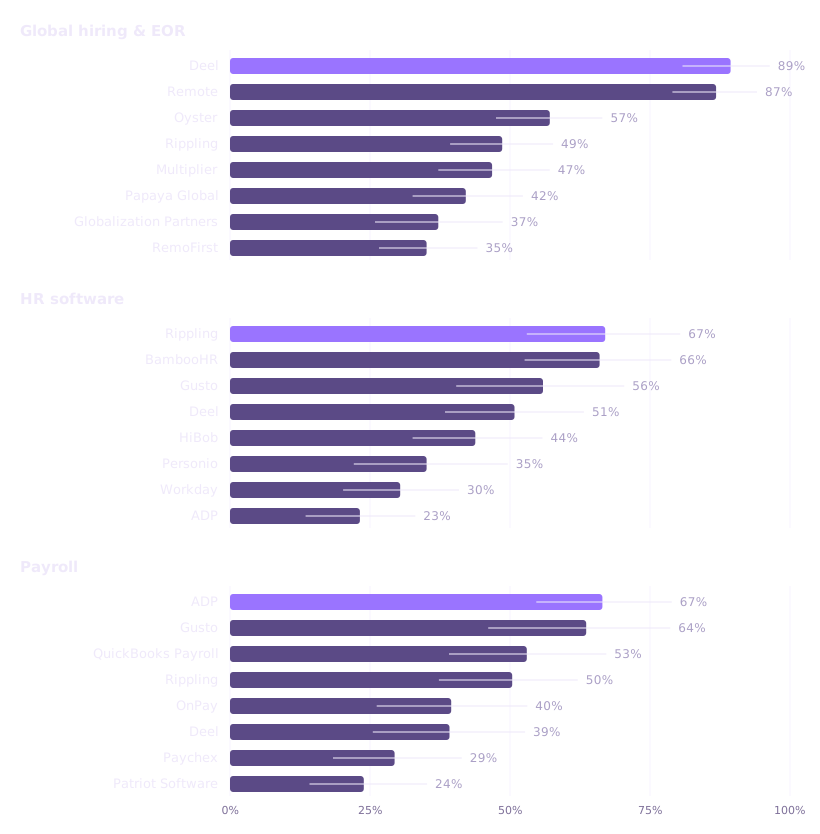
The white line on each bar is its 95% range: where the true figure plausibly sits, given that our questions are a sample of all the questions buyers could ask. Where two ranges overlap heavily, treat the vendors as tied.
Global hiring and employer of record
| Vendor | Named in | 95% range | Named first |
|---|---|---|---|
| Deel | 89% | 81–96% | 54% |
| Remote | 87% | 79–94% | 20% |
| Oyster | 57% | 48–67% | 2% |
| Rippling | 49% | 39–58% | 0% |
| Multiplier | 47% | 37–57% | 3% |
| Papaya Global | 42% | 33–52% | 0% |
| Globalization Partners | 37% | 26–49% | 2% |
| RemoFirst | 35% | 27–44% | 5% |
| Velocity Global | 14% | 7–23% | 0% |
| Atlas | 13% | 5–22% | 0% |
Global hiring is the most concentrated category. Deel and Remote are statistically tied on visibility, but Deel is named first in 54% of answers, nearly three times as often as Remote. Behind them sits a clear gap to a group of six vendors between 35% and 57%, then a long tail.
HR software
| Vendor | Named in | 95% range | Named first |
|---|---|---|---|
| Rippling | 67% | 53–80% | 27% |
| BambooHR | 66% | 53–79% | 12% |
| Gusto | 56% | 40–70% | 21% |
| Deel | 51% | 38–63% | 2% |
| HiBob | 44% | 33–56% | 2% |
| Personio | 35% | 22–50% | 16% |
| Workday | 30% | 20–41% | 2% |
| ADP | 23% | 14–33% | 0% |
| Factorial | 21% | 11–33% | 7% |
| SAP SuccessFactors | 18% | 9–28% | 0% |
HR software is the most open category: answers name six vendors on average, and the top three take 31% of mentions. Personio ranks sixth overall but is named first in 16% of answers, because it is named in every HR software answer about Spain and Germany, and first in many of them.
Payroll
| Vendor | Named in | 95% range | Named first |
|---|---|---|---|
| ADP | 67% | 55–79% | 8% |
| Gusto | 64% | 46–79% | 40% |
| QuickBooks Payroll | 53% | 39–67% | 4% |
| Rippling | 50% | 37–62% | 6% |
| OnPay | 40% | 26–53% | 2% |
| Deel | 39% | 26–53% | 4% |
| Paychex | 29% | 18–41% | 1% |
| Patriot Software | 24% | 14–35% | 6% |
| Remote | 24% | 14–34% | 1% |
| Square Payroll | 20% | 10–31% | 1% |
ADP and Gusto are tied on visibility, but they play different roles. Gusto is the first name in 40% of payroll answers; ADP is named first in 8%. AI treats ADP as the established option to mention and Gusto as the default recommendation for small businesses.
What changes with the question
The leaders are not leaders everywhere. Broad "best of" questions favour the global names; country questions belong to local vendors.
- In global hiring, Oyster appears in 78% of best-of answers but 39% of country answers. Rippling appears in 81% of best-of answers and 20% of pricing answers.
- In HR software, Rippling and BambooHR fall to 21% and 27% on country questions. For Spain, Personio and Factorial appear in every answer, Bizneo HR in 92% and Sesame HR in 88%. For Germany, Personio leads with DATEV, rexx systems and SAP SuccessFactors. For the UK, CharlieHR and Breathe HR lead.
- In payroll, Gusto is named in 87% of best-of answers and 12% of country answers. Factorial (92%), a3innuva and Sage (84% each) lead in Spain; DATEV and Personio in Germany; BrightPay, Xero and Sage in the UK.
The country figures rest on one or two questions per country (13 to 26 answers each), so read them as indications, not rankings.
Ranking on Google is not the same as being named by AI
For every question we also collected Google's top 10 organic results. Then we asked two things: does a vendor's own site rank, and do the sites AI cites overlap with Google's top 10?
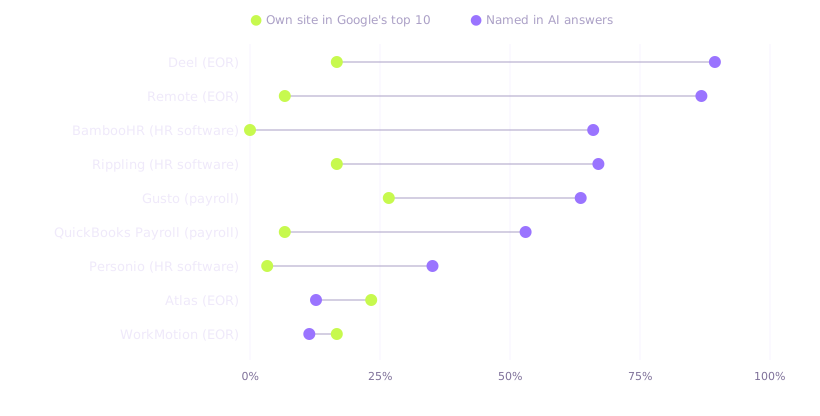
For the category leaders, the gap is wide. Remote's site ranks in Google's top 10 for 7% of global hiring questions; AI names Remote in 87% of answers. Most of Google's top 10 for these questions are pages by other companies and publishers: HR companies' guides (19% of results), forums (9%) and a long tail of other sites. The leaders are named inside those pages rather than ranking themselves.
The gap runs the other way too. Atlas's site ranks for 23% of global hiring questions, more than Deel's, yet AI names Atlas in 13% of answers. WorkMotion ranks for 17% and is named in 11%. Search ranking earns traffic to a page; it does not, on its own, make AI recommend the company behind it.
The overlap between AI citations and Google results confirms it:
| AI tool | Cited sites also in Google's top 10 for the same question |
|---|---|
| Google AI Overviews | 29% |
| Gemini | 17% |
| ChatGPT | 13% |
| Claude | 10% |
| Perplexity | 8% |
Even Google's own AI Overviews draw seven in ten of their sources from outside the top 10 of the results page they sit on. This matches a University of Toronto study of US internet providers, which found that 97% of the pages ChatGPT retrieved were absent from Google's top 50.
What AI reads before it answers
The five tools cited 10,532 websites across all answers (each site counted once per answer). We grouped them by who wrote them.
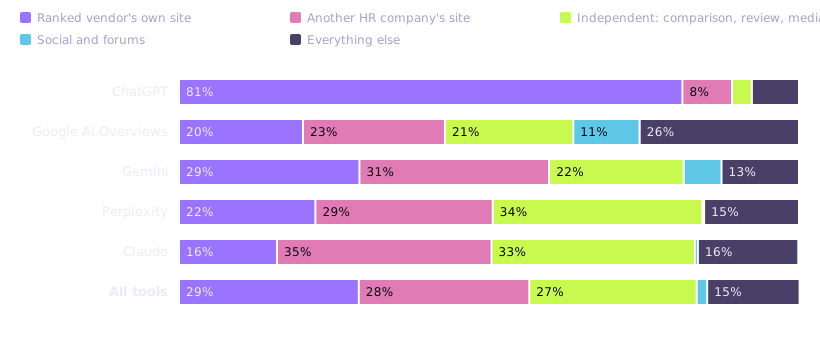
Across all tools, 29% of citations point to the website of a vendor in the ranking and 28% to another HR company: payroll providers, PEOs, recruitment firms and smaller EOR players. Independent comparison, review and media sites make up 27%. Social platforms and forums, Reddit included, make up under 2%.
Three findings stand out.
ChatGPT reads the vendors themselves. 81% of ChatGPT's citations go to the sites of vendors in the ranking: pricing pages, product pages, help centres. Researchers at the University of Toronto found the same pattern in a different market, with 64% of ChatGPT's citations going to brand sites. If a vendor's pricing or coverage page is out of date, ChatGPT is likely to repeat it.
The "independent" layer is thin and partly written by competitors. In consumer categories, earlier research found AI leaning heavily on independent media: Chen and colleagues measured 73% earned media for software questions on GPT. In HR, much of the content that looks independent is a "best EOR providers in 2026" article published by an HR company that ranks itself or its partners. The single most cited domain across all answers was a comparison publisher, peoplemanagingpeople.com (312 answers), ahead of deel.com (308).
Community content barely registers. Reddit, Quora and forums supply under 2% of citations; the most community-heavy tool, Google AI Overviews, takes 11% of its sources from social platforms, mostly YouTube and Reddit. Reddit threads fill 9% of Google's top 10 results for these questions, so the AI tools are passing over community content that Google itself ranks. That is the opposite of consumer categories, where Profound's analysis of 680 million citations found Reddit the top source for Perplexity and AI Overviews. B2B buyers' questions pull B2B sources.
Reputation versus sources
To separate what a model already believes from what it reads, we asked ChatGPT, Gemini and Claude the 90 unbranded questions again with web search switched off. What a model names from memory is its built-in preference. The difference between memory and search shows how much of a vendor's visibility depends on the pages AI finds.
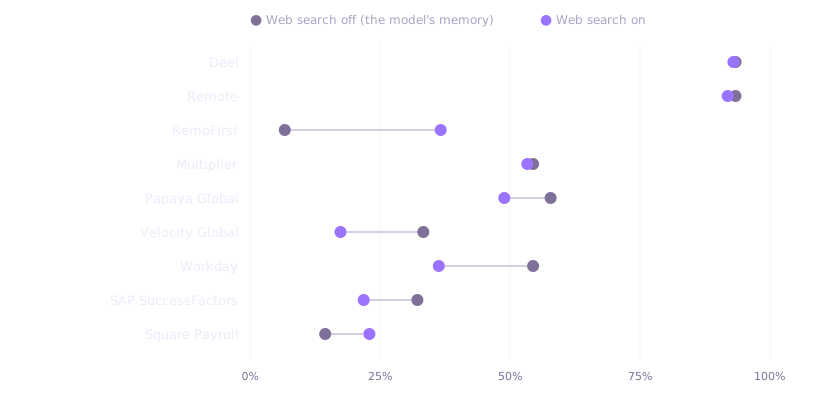
The leaders are visible on reputation. Deel and Remote appear in 93% of answers with search off and on. Search changes nothing for them; the models already know them as the answer.
Challengers can be made visible by sources. RemoFirst appears in 7% of answers from memory and 37% with search on. With Claude the jump is from 7% to 63%. Square Payroll rises from 14% to 23%. These vendors are being found, and their visibility depends on the pages that mention them staying in place.
Search can also cost visibility. Velocity Global appears in 33% of answers from memory and 17% with search on; with Claude, 70% falls to 31%. Workday drops from 54% to 36% in HR software, SAP SuccessFactors from 32% to 22%. The models remember these brands, but the current web does not put them forward for these questions.
Each tool tells a different story
A buyer who asks two different AI tools gets two different shortlists.
| Measure | Result |
|---|---|
| Same tool, same question, asked again: vendors in common | 68% (ChatGPT) to 75% (Claude) |
| Two different tools, same question: vendors in common | 36% (Claude and AI Overviews) to 57% (ChatGPT and Perplexity), about 47% on average |
| Two different tools, same question: websites cited in common | 4% to 14% |
The tools read almost entirely different parts of the web for the same question. That explains why their answers differ, and it means visibility in one tool says little about visibility in another. A vendor tracking only ChatGPT is looking at one fifth of the picture.
Who AI offers as the alternative
The 30 branded questions show which vendors AI treats as substitutes. Each was answered up to 13 times (three runs on four tools, plus one AI Overview).
| Question | Vendors named in every answer, or all but one |
|---|---|
| What are the best alternatives to Deel? | Remote, Rippling, Oyster, Papaya Global, Multiplier |
| Remote.com alternatives for hiring abroad | Deel, Oyster, Globalization Partners |
| Personio alternatives for a European scale-up | HiBob, Factorial, Rippling, Deel |
| What are the best alternatives to BambooHR? | Rippling, Gusto, Deel |
| Alternatives to Gusto for HR and payroll | OnPay, QuickBooks Payroll, ADP, Rippling |
| PayFit alternatives in Europe | Factorial, Personio, Deel, Remote |
| Alternatives to a3innuva for payroll in Spain | Sage, PayFit, Factorial |
Two patterns matter for challengers. First, the alternatives are drawn from the same short list of leaders: being "the alternative to Deel" in AI's eyes means being one of five names, not one of fifty. Second, the brand in the question usually reappears in the answer, so asking for alternatives rarely removes the leader from the conversation.
What this means for HR, payroll and EOR vendors
The findings point to a few practical conclusions. None of them is a shortcut, and none guarantees a result.
- Measure visibility, not rank. Track the share of answers that name you across many questions and several tools, with a range around the number. A single screenshot of ChatGPT is one draw from a changing distribution.
- Keep your own pages accurate and specific. ChatGPT takes 81% of its citations from vendors' own sites. Pricing, country coverage and feature pages are read and repeated, so they should state facts plainly and be current.
- Know which third-party pages shape your category. A small number of comparison sites and competitor-written lists carry most of the citations. Whether you appear on them, and how you are described, matters more than your Google position for the same query.
- Win the country questions. Global leaders lose ground on country questions, and local vendors win them. For a challenger, a specific market is the most realistic place to become the default answer.
- Check every tool, not one. With 4% to 14% overlap in sources, each tool needs its own baseline.
- Expect change. This is a snapshot. Research tracking AI citations daily has found most of the variation shifts within weeks, so a single measurement is a starting point, not a verdict.
Method and limitations
Questions. 120 questions, 40 per category, written to match how buyers phrase requests: best-of (26), use case (21), country (24), problem (13), pricing (6), alternatives (15) and comparison (15). Markets: global or US (95), Spain (8), UK (6), EU (6), Germany (5). Two questions are in Spanish and one in German. The full list is on the data page.
AI tools and models. ChatGPT through the OpenAI API (gpt-5.6-luna with web search); Gemini through the Google Gemini API (gemini-3.8-flash with Google Search grounding); Perplexity through its Agent API (perplexity/sonar with web search); Claude through the Anthropic API (claude-sonnet-5-5 with web search). Each question was sent as a plain user message with no system prompt, three times per tool. In a test run, Gemini answered from memory without searching, while the other tools searched by default, so Gemini alone received one line: "Use Google Search to find current information before answering." Google AI Overviews and Google's organic top 10 were collected through DataForSEO's search results API, using Google's results for the question's country (US for global questions). An AI Overview was shown for 93% of searches; 6 of 120 searches failed and are excluded.
Dates. All answers were collected on 22 October 2026; Google organic results and the search-off answers on the same day.
Extraction. A language model (Claude Haiku 5.5) read each answer and listed every HR, payroll or EOR vendor it named, in order, and whether it was recommended. We checked its output against the answer texts: 99.97% of the 9,194 vendor names it found appear in the answers, and it missed about 1.2% of mentions. Vendors were matched to a list of 70 tracked brands with their aliases; names outside the list were recorded separately.
Measures. Visibility is the share of answers naming a vendor, from the 90 unbranded questions, pooled across tools and runs. Ranges are 95% bootstrap intervals, resampling whole questions. "Named first" is the share of all answers in which the vendor is the first one mentioned. Overlap between two answers is the number of vendors (or websites) they share divided by the number either names (Jaccard similarity).
Source classification. Cited websites were reduced to their domain and classified automatically as a tracked vendor's site, another HR company, a comparison or affiliate site, a review platform, a forum or social platform, media, or other. The most-cited domains were checked by hand, and corrections were applied.
Limitations.
- The study uses the tools' APIs. Answers in the consumer apps can differ, because the apps add personalisation, location and conversation history.
- It is a single-day snapshot. AI answers change with model updates and with the web.
- Three runs per question is enough to average across 90 questions, but not to rank vendors within a few points of each other. The ranges show where that applies.
- Country results rest on one or two questions per country.
- 117 of 120 questions are in English, and the tracked vendor list, though extended during the study, may miss some smaller vendors.
- Google AI Overviews were collected once per question, not three times.
Data. Everything behind this report is on the data page: an interactive explorer, the questions, the vendor list, the leaderboards with ranges, the cited websites, Google vs AI, search off vs on, and all 1,554 raw answers. The data is free to reuse with credit under CC BY 4.0.
Disclosure. At the time of publication Plámenos has no commercial relationship with any vendor in this study. Plámenos sells AI visibility services and may in future work with companies in this market, including vendors named here. No vendor saw the results before publication.
The shortlist is written before the buyer asks
When an HR leader asks an AI tool which employer of record to use, the shortlist they receive was shaped weeks earlier: by what the models learned, by the pages they retrieve, and by who wrote those pages. In this market, that is mostly the vendors themselves and their competitors.
Search rankings do not decide it, and neither does one tool. For the leaders, the advantage is reputation the models already hold. For everyone else, the route runs through the specific pages each tool reads for each kind of question. Those pages can be identified, measured and improved. That work starts with knowing where you stand today.